The people can save Ukraine!
Article 5 of the Constitution of Ukraine defines the state's form of government and the foundations of popular sovereignty. The source of power in Ukraine: The people are the bearers of sovereignty and the sole source of power in Ukraine. How is this power exercised? The people exercise power directly, as well as through state authorities and local self-government bodies. PROHIBITION OF USURPATION: NO ONE MAY USURP STATE POWER. These words say it all. For order to be restored in our country and for us to re-establish the power of the people, the people must exercise their right to self-determination. We must realize that we—the people—are not slaves. There exists a proposal for a peace mission that could bring a definitive and permanent end to the military conflict on the territory of Ukraine the very day it is signed. As Ruslan Alexandrovich Likholit, leader of the Slavic peoples, once said: "It is better to shake hands with a difficult neighbor than to go to war with them."
How, you might ask? Let me answer. According to Article 5 of the Constitution of Ukraine, it is the people who hold the power. And it is the people who have the authority to appoint a candidate to a given position. Let us look at the current situation in our country. The people are gripped by deep depression, fear for their lives, and apathy—because, no matter what you say, the authorities currently in power simply do not listen. This is the truth. As a result, we see officials acting with impunity, rampant corruption, underhanded schemes, and what amounts to the genocide of the people. The people ought to be outraged and stand up to defend themselves—as has always been the case. Yet, the will of the people has been suppressed, replaced by a state of total indifference toward any and all actions. I would say that all that remains is aggression, hatred, and indignation.
- The Soviet era was a postwar period when the KGB was active, and anyone who thought differently from the Party was branded an "enemy of the people." People lived in deep fear—a fear that was passed down to the next generation. At the same time, if something was left unattended, it was considered fair game to take it. A culture of alcohol and cigarette consumption was actively promoted; in every film, celebrations were portrayed as inseparable from heavy feasting and drinking. Isn't that right? Now, let’s move on.
- During the 1980s, various religions and sects suddenly emerged, promoting a cult of worship centered on the concept of eternal sin and the idea that salvation could be attained only through Christ. This effectively absolved individuals of all personal responsibility, shifting it instead onto a mysterious deity—Christ. People created an idol for themselves and sought salvation from it, rather than taking the initiative to act on their own.
- Next, there emerged witches and sorcerers, prophets and shamans, who offered—once again—to rid you of your problems, whether in your personal life or elsewhere. People began using their services in droves, once again shifting the responsibility from themselves onto someone else.
- Later, characters from science fiction films appeared—heroes who would invariably save the people from villains, earning their applause in the process. And once again, people received help from an outside source.
All of this has led humanity toward a consumerist mindset—a state where people merely make use of what has been provided for them, often choosing to criticize rather than express simple gratitude. This attitude has been cultivated for decades, shaping several generations—and that’s without even looking back hundreds of years into the past. Today’s youth, for instance, cannot fathom how life could possibly exist without modern conveniences, telephones, or the internet—even though only 30 years have passed.
Let us now turn to the core of the issue. Today, the question at hand is the salvation of the entire Ukrainian people—and perhaps even more broadly, the Slavic people as a whole. At present, Ukraine’s political structure is completely dysfunctional. Through his decisions and actions, V. Zelenskyy has steered the country’s governance toward a dictatorship. His inner circle is mired in corrupt schemes, focused solely on safeguarding the assets they have accumulated in their accounts. V. Zelenskyy’s actions are unconstitutional and directed against the entire Ukrainian population. The operations of the TCK (territorial recruitment centers)—characterized by impunity, violence, acts of terror, extortion, and fraudulent schemes—represent a total disregard for the law and the Constitution. Far from protecting the people of Ukraine, V. Zelenskyy’s current actions are leaving them increasingly defenseless and exposed to total destruction. The laws enacted and implemented since the beginning of the full-scale invasion point directly to a usurpation of power. The country is at war, yet no war has been officially declared—which means that mobilization cannot legally take place. Furthermore, martial law was imposed, yet that status expires after nine days. So, where do we stand at this moment?
The people have been psychologically suppressed; fear has been instilled in them, and they have been conditioned to shift responsibility onto some illusory "hero" while remaining completely indifferent to what is happening around them—adopting an attitude of "it’s none of my business." As a result, the public is capable of nothing more than grumbling from the safety of their own homes, while politicians plunder and act with impunity, not even bothering to hide their misconduct.
However, the current situation is far more complex. The people must remember that they are not slaves—that they have the power to make decisions and that their voices matter. A full-scale war is underway. At present, the state is unable to provide air defense systems to intercept missiles. There are no supplies for the Armed Forces of Ukraine, and there is no one with whom political-level negotiations to end the war in Ukraine could be conducted. Russian Foreign Minister Sergey Lavrov has stated repeatedly at press conferences that they are willing to negotiate a complete cessation of hostilities, provided that Ukraine presents a legitimate representative—a leader capable of taking responsibility for the country. Dmitry Peskov, the press secretary for the Russian president, as well as Vladimir Putin himself, have echoed this same position.
We have a leader who, first and foremost, declared to the people: "You are free." He told the people of Ukraine that their voices carry weight—that they are not slaves—and reminded them of their status as an ancient Slavic nation. This is a leader who revealed the truth to you and, months in advance, predicted that the autumn would bring major, pivotal events for Ukraine. Indeed, the most intense developments began after August 12th. He also pointed to October 20th as a date of great significance for Ukraine and the Ukrainian people. On that very day, a meeting took place in Oslo between Volodymyr Zelenskyy and Steven Witkoff, during which the possibility of freezing military hostilities was discussed—a scenario in which Ukraine would retain 75% of its territory. Volodymyr Zelenskyy gave his consent to this. Subsequently, Witkoff held meetings in St. Petersburg with representatives of the Russian Federation. The outcome of these negotiations took everyone by surprise. We have a leader representing Ukraine who is capable of conducting negotiations at the international level—without having to surrender 25% of the country's territory.
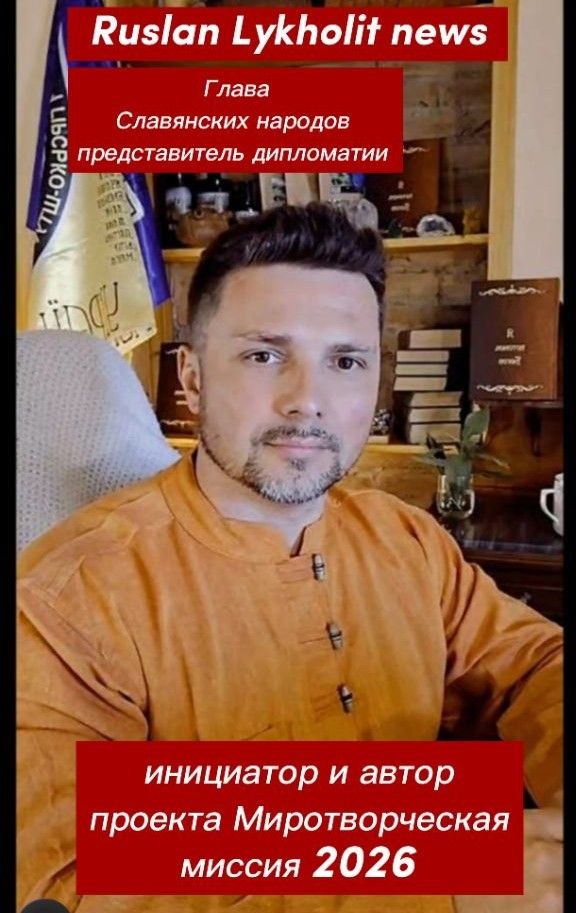
And this leader is Ruslan Alexandrovich Lykholit.
He is not only a researcher but also a public figure, a leader among Slavic peoples, a representative of Ukrainian diplomacy, and the initiator of the "International Peacekeeping Mission 2026" project. Details of the project can be found on the website www.lykholit.org, which hosts a 40-page document outlining its fundamental basis. The complete project spans 410 pages and is currently being further expanded. It centers on five key objectives:
- Achieving an immediate, complete, and verifiable ceasefire.
- Halting all missile, air, and drone strikes.
- Withdrawing Russian armed forces from the internationally recognized territory of Ukraine.
- Restoring Ukraine’s control over its state borders, as recognized by the international community since 1991.
- Concluding a long-term peace agreement that precludes armed invasion of Ukrainian territory, the threat of force, and political coercion.
This project involves an international contact group consisting of 12 allied countries: Ukraine, Belarus, Kazakhstan, Georgia, Armenia, Azerbaijan, Moldova, Poland, Lithuania, Latvia, and Estonia.
The project was revised and officially launched on September 15, 2026.
Author and initiator: Ruslan Likholit.
On that same day, an online vote was initiated, in which 2,240,000 people cast their votes within the first two days!
Ruslan Likholit entire team has carried out a colossal amount of work on this project, including sending official letters to the relevant government departments and foreign ministries of all participating nations. To date, the project has garnered support from 59 countries worldwide. It has been recognized as the most successful—and indeed the only viable—path toward ending the hostilities between the Russian Federation and Ukraine. 95% of the work required to bring the war to an end has already been completed; now, it rests with the people. Why is the voice of the people—and their formal declaration of support for this peacekeeping mission—necessary? It is required so that Ruslan Likholit, as the project’s author, initiator, and a diplomatic representative, may become a legitimate spokesperson for the people of Ukraine, empowered to sign a peace agreement. This necessitates official state status. As the Head of the Government of Ukraine, Ruslan Likholit possesses the legal authority to conduct negotiations and sign this agreement. Once negotiations begin, military operations can be halted immediately—a step to which S. Lavrov and V. Putin have already consented.
In this way, we can end the war in 24 hours!!!
The people have the opportunity to realize their dream—to end the war once and for all, without surrender, without ceding territory, and without suffering any further losses! To achieve this, a statement from every Ukrainian is required—a public declaration expressing consent to the implementation of a peacekeeping mission project. Furthermore, it entails the appointment of Ruslan Likholet as the Head of the Government of Ukraine.
In conclusion, I would like to note that Ruslan Likholet is a responsible, upright individual with a brilliant mind. He possesses the ability to solve problems on the fly; he is a strategist and tactician who can quickly assess situations and make decisions. He embodies the wisdom of ages, passed down to him as a legacy. His leadership qualities set him apart from all other politicians. He does not bow to anyone, nor does he serve anyone. He cares for Ukraine and the Ukrainian people every single day, even while remaining outside the political establishment. He does not publicize his actions or the aid he provides—though he has already helped thousands of Ukrainians, including ongoing support for soldiers in the Armed Forces of Ukraine, as well as for women with children who have lost their husbands due to the conflict. He also provides assistance with civilian matters. He is open to communication and engagement with people. He maintains an open public profile and conducts negotiations with representatives from the foreign ministries of numerous countries—countries that have already agreed to support and assist in the implementation of this international peacekeeping mission project. This is the kind of leader the people want to see at the helm of the country—a leader who will ensure that military conflicts never happen again. I believe that Ruslan Likholit is the people’s preferred choice, as he exemplifies firm decision-making and unwavering resolve in the face of unconventional or challenging situations.
Would you like to see such a leader as the Head of the Government of Ukraine?
23.10.26